Special Guardianship Orders: A National Conversation About Permanence
26th February 2026
Across the country, there is an increasing focus on Special Guardianship Orders (SGOs) as part of the wider drive to secure permanence for children in long-term foster care.
This national conversation is important. Permanence matters. Stability matters. For many children, an SGO can provide both.
However, as the system reflects on how and when SGOs are considered, it is equally important that the conversation remains balanced, informed and child-centred.
What is an SGO?
A Special Guardianship Order grants carers enhanced parental responsibility for a child until the age of 18. It offers legal security and permanence without severing legal ties with birth parents, as adoption would.
For some families, SGOs can provide:
- Long-term stability
- Greater autonomy
- A strengthened sense of belonging
- Reduced statutory involvement
When the timing and circumstances are right, an SGO can be transformative.
Why the National Debate Matters
The current national drive to explore SGOs for some long-term fostering arrangements is often linked to:
- Performance planning expectations
- Reducing drift in care
- Care sufficiency pressures
- The wider aim of reducing the number of children formally "in care"
While these objectives are understandable at a system level, permanence decisions must never be system-led alone.
An SGO is not simply a legal change. It fundamentally alters the support framework around a child and their carers.
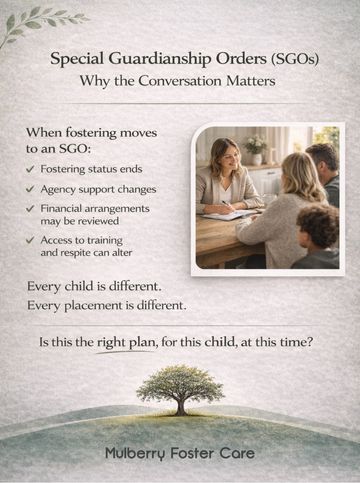
Typically, when a placement moves from fostering to SGO:
- Fostering status ends
- Supervising social workers involvement ceases
- Wraparound fostering support is reduced or withdrawn
- Access to training, respite and agency-based service changes
- Financial services may be reassessed
For children who have experienced trauma, neglect or complex needs, this shift in professional support is significant.
Timing and Stability
Nationally, practitioners are increasingly discussing the importance of timing.
Children need stability, therapeutic input and settled attachments before legal transitions are considered. Carers need to feel confident, secure and properly supported.
An SGO should represent a strengthening of permanence — not a step taken before needs are fully understood or support structures are secure.
Avoiding Blanket Approaches
There are wider sector discussions about the risks of blanket encouragement of SGOs for long-term foster carers.
Every child’s story is different.
Every carer’s capacity and support network is different.
Every placement has its own dynamics.
Permanence planning must remain rooted in assessment, not targets or trends.
Ethical Conversations About SGOs
As part of this national discussion, conversations about SGOs must be clear, balanced and transparent.
An SGO should never be presented as:
- A way to "remove" social work involvement
- A solution to short-term challenges
- An administrative simplification
- A default next step for long-term placements
SGOs are about permanence — not process.
The Bigger Picture
The sector continues to evolve, and the drive toward stronger permanence planning is welcome. However, as a profession, we must ensure that:
- Children's needs remain central
- Support structures are honestly explained
- Carers are fully informed
- Decisions are based on readiness, not pressure
- Permanence strengthens stability rather than reducing support prematurely
The key question in every case remains:
Is this the right plan, for this child, at this time?
Permanence is powerful — but it must always be purposeful.
Read more